

Reading the Room.
The skill I used undercover, the science behind why it works, and four things anyone can do today to walk into any situation with an advantage.


I spent time working undercover on a number of sensitive projects. My job was to blend in, build trust and gather intelligence without anyone knowing who I was or why I was there.
There was no room for error, if someone decided they did not trust me the consequences were immediate. So I learned very quickly that the most important skill I had was not physical, not tactical and not technical. It was the ability to read the people around me in real time and respond to what I found.
I had to match the energy of the people around me before I said a single word. I had to mirror posture, pace and language without making it obvious. I had to notice when someone’s mood shifted, when trust was building or eroding, when a conversation was about to change direction. I had to do all of this while appearing to be entirely relaxed and present.
That is what reading the room looks like at an operational level. What I want to share in this piece is why the underlying skill works, what the science says about it, and how anyone can begin to develop it regardless of their background or profession.
What the research says:
Reading the room is not intuition in the mystical sense. It is pattern recognition built on observable, measurable signals - and there is a substantial body of research that explains exactly why it works.
The science behind it:
01
PAUL EKMAN - MICRO EXPRESSIONS
Psychologist Paul Ekman spent decades researching facial expressions and identified seven universal emotions expressed the same way across every culture on earth: happiness, sadness, fear, disgust, anger, surprise and contempt. More significantly, he identified micro expressions, involuntary facial movements that last between one twenty-fifth and one fifth of a second, which reveal true emotional states even when a person is actively trying to conceal them. Once you know what to look for, they are extremely difficult to hide.
02
ALBERT MEHRABIAN - THE COMMUNICATION SPLIT
Mehrabian’s research found that in emotional communication only 7% of meaning is conveyed through the words themselves, 38% comes from tone of voice and 55% percent from body language. The figures are specific to emotional context rather than all communication, but the principle holds broadly: what people say is often the least reliable indicator of what they actually mean. The body and the voice tell a more honest story.
03
JOE NAVARRO - FBI BEHAVIOURAL ANALYSIS
Former FBI Special Agent Joe Navarro spent twenty five years reading people professionally and identified the limbic system as the key to reliable body language analysis. Unlike the cortex, which controls conscious thought, the limbic brain responds automatically and honestly to threat, comfort and stress. Navarro’s work established that limbic responses - freeze, flee, fight - manifest physically in ways that trained observers can detect long before any verbal communication takes place.
04
NICHOLAS EPLEY - SOCIAL INTELLIGENCE RESEARCH
University of Chicago psychologist Nicholas Epley found that most people significantly underestimate their ability to read others accurately and significantly overestimate how well others can read them. His research suggests that social intelligence is a trainable skill and that the primary barrier to developing it is not capacity but attention. Most people simply are not paying close enough attention to the signals that are already there.
Micro Expressions:
Micro expressions are worth spending a moment on because they are the most specific and actionable element of reading the room and the one that most people have never heard of.
To be clear - they are involuntary. A person cannot choose to suppress them the way they might choose not to say something. They flash across the face in a fraction of a second, too fast to be caught by someone who is not looking for them, but entirely visible to someone who is.
In my undercover work, micro expressions were often the first signal that something had shifted. A flicker of contempt when I said something that did not quite fit. A moment of surprise that told me they knew more than they were letting on.
The face does not lie as quickly as the mouth does. There is always a gap between the genuine reaction and the managed one, that gap is where the information lives.
Ekman categorised the seven universal micro expressions as follows:
01 Happiness is characterised by raised cheeks and crow’s feet around the eyes - a genuine smile involves the eyes in a way that a performed one does not.
02 Contempt appears as a unilateral lip raise, almost always on one side only, and is one of the most significant signals in any negotiation or trust-building context.
03 Fear involves raised and pulled-together brows, raised upper eyelids and stretched lips.
04 Anger shows as lowered brows pulled together, tense lower lids and pressed or open lips.
05 Disgust involves the nose wrinkle and upper lip raise.
06 Sadness produces inner brow raises and downturned lip corners.
07 Surprise, often confused with fear, produces raised brows in a curved rather than straight line.
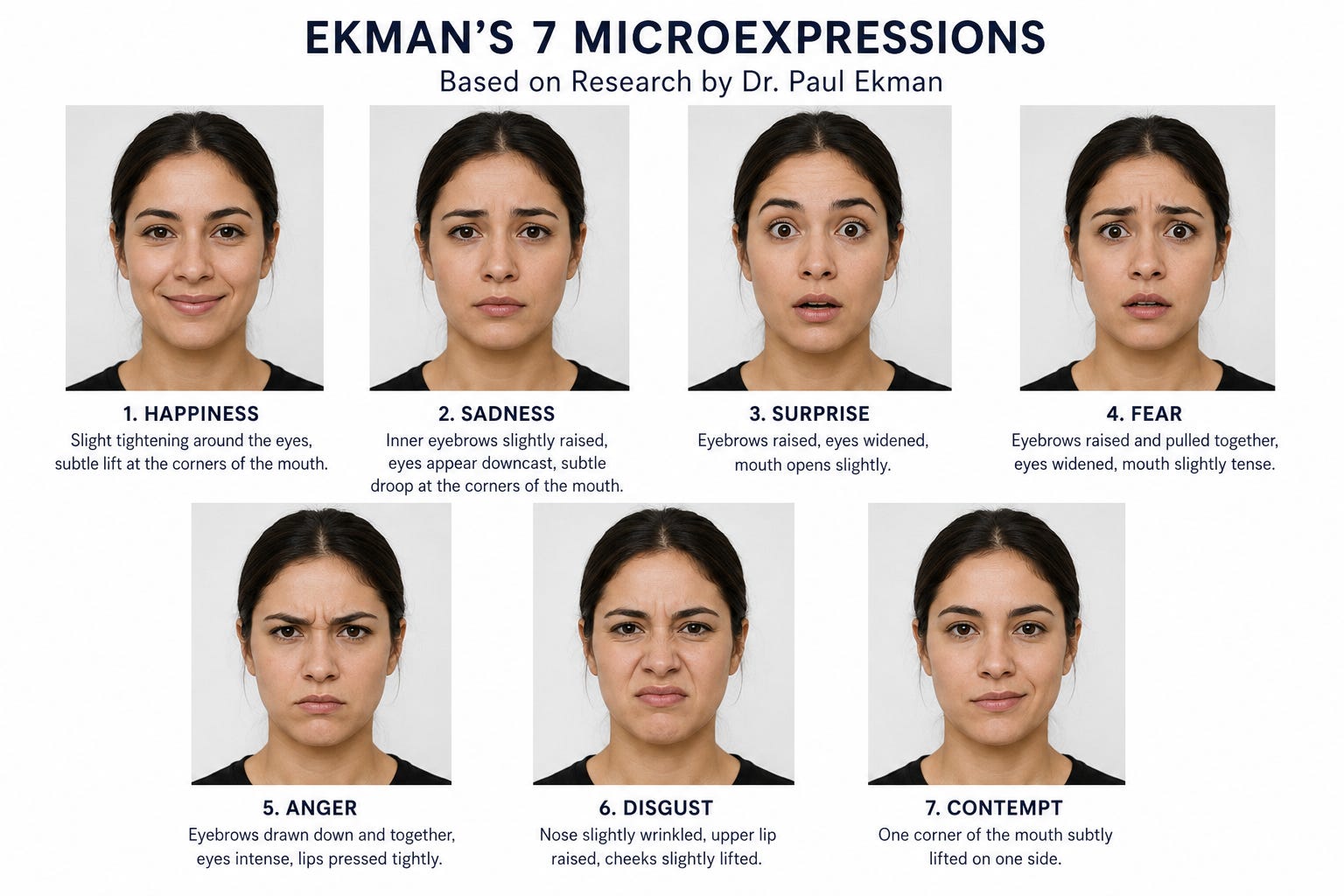
You do not need to memorise all of these to benefit from this knowledge. The single most useful thing is simply to slow down and look at the face rather than listening only to the words. The face will almost always give you more accurate information.
Mirroring and Rapport:
When I was working undercover, mirroring was not a technique I used consciously at first. It was something I noticed happening naturally when I was genuinely engaged with someone, and something I learned to use deliberately once I understood what it was doing.
Mirroring is the unconscious copying of another person’s body language, speech patterns, pace and energy. Research by psychologist Tanya Chartrand at Duke University found that people who are mirrored by others report higher levels of liking, trust and rapport with that person without being able to identify why. The effect is subconscious and powerful.
In an undercover environment, where trust was the only currency that mattered, mirroring was one of the most effective tools I had. Not exaggerated or obvious copying (that has the opposite effect) but a gradual, natural synchronisation of posture, pace and energy that signals to the other person’s limbic brain that you are safe, aligned and on the same side.
The same principle applies in every negotiation, sales conversation, difficult meeting or first impression. People trust people who feel like them. Mirroring, done well and done genuinely, accelerates that feeling.
The signals worth knowing:
Beyond micro expressions and mirroring, there are four categories of signal that consistently provide reliable information about what is actually happening in any room.
01
OPEN PALMS
Showing the inside of the hand is one of the oldest trust signals in human behaviour, rooted in the evolutionary need to demonstrate that you are carrying no weapon. People who keep their hands visible and open are subconsciously signalling openness and non-threat. People who hide their hands in pockets, under tables or behind their back are often processing discomfort, concealment or defensiveness. In any context where trust matters, keeping your hands visible is one of the simplest and most effective adjustments you can make.
02
FEET
Feet are controlled by the oldest part of the brain and are therefore one of the most honest signals in body language. While a person can consciously manage their facial expression and upper body posture, they rarely think about their feet. Feet point where the brain genuinely wants to go. Someone whose torso is facing you in conversation but whose feet are pointing toward the door has already disengaged, regardless of what their face is doing. This is particularly useful in any setting where you want to understand who is genuinely present in a conversation and who is looking for an exit.
03
MIRRORING
When someone unconsciously copies your posture, pace or gestures, they are in rapport with you. The mirroring itself is not the signal — it is the change that matters. When someone who has been mirroring you stops, something has shifted. They have disengaged, become uncomfortable or made a decision about the interaction. Notice the change, not the gesture, and respond to what it tells you rather than what the words are saying.
04
SELF-SOOTHING
Touching the face, neck, hair or collarbone under pressure is the body’s way of calming itself down. The neck in particular contains a high concentration of nerve endings and touching it releases a small amount of stress. Navarro identified neck touching as one of the most reliable indicators of discomfort, deception or anxiety in his FBI work. Once you know what self-soothing looks like, you will notice it everywhere - in press conferences, negotiations, difficult conversations and everyday interactions. It is not subtle once you are looking for it.
Four things you can do today:
None of this requires specialist training to begin using. These four adjustments will immediately improve how you read and how you are read in any situation.
01
SHOW YOUR HANDS
Keep them visible and open, on the table in meetings and not in your pockets, because people decide how much they trust you before you open your mouth. This single adjustment changes how people receive you from the first moment of contact.
02
ARRIVE EARLY
The first few minutes are your calibration window and it is much harder to read a room you just walked into. Arriving before you need to gives you time to establish the baseline - what normal looks like in this environment, with these people, at this time - so that any deviation from it is immediately visible.
03
MATCH THE ENERGY
Read the room before you speak. People respond to someone who understands the mood without being told. Walk in and assess before you contribute, because the person who calibrates to the room before speaking is always received better than the person who arrives with a fixed energy and imposes it.
04
GIVE WHAT’S NEEDED
Not what you planned to say. What you say is important, but people mostly remember how a room felt when you were in it. The ability to read what a room needs and provide that (rather than delivering a prepared version of yourself) is what separates people who are genuinely influential from people who are merely present.
This is not a security skill or a leadership skill. It is a human skill and anyone can develop it.
Safety and Security. From someone hired to protect.
"Reading the Room” is a sharp, practical, and highly readable piece from Black Widow Security. The post takes a skill often treated as vague intuition and reframes it as disciplined observation: noticing facial expressions, posture, tone, mirroring, discomfort signals, and shifts in energy before words tell the whole story. What makes it especially strong is the blend of real undercover experience with accessible references to behavioral research, including micro expressions, rapport-building, and nonverbal communication. The advice is immediately useful, especially the reminders to show your hands, arrive early, match the room’s energy, and respond to what the situation actually needs. It is a valuable read for anyone interested in security, leadership, communication, or simply becoming more socially aware.”
R/
Dr. Russo