

Stop Scrolling. This Could Save Your Life.
Water safety: what to do if you or someone nearby is struggling in water.

Please restack/share this article to get this important message to as many readers as possible.
Eleven people have died in open water in the United Kingdom since Sunday the 24th of May 2026. 12 Seven of them were children and teenagers, and their deaths stretched across the country from Cornwall to Yorkshire and from Wales to Hampshire, during what has been the hottest Bank Holiday weekend this country has ever recorded.
I am not writing this to create panic or to tell you not to enjoy the water. I am writing it because what has happened this week follows a pattern that repeats every summer in this country, and because the single most important thing you can do to protect yourself and the people around you, is understand something that most people simply do not know.
The water looks warm and inviting, in this heat, the surface may even feel warm. Below it, UK rivers and lakes are cold enough to stop your body working within seconds.
From My Work on the Water
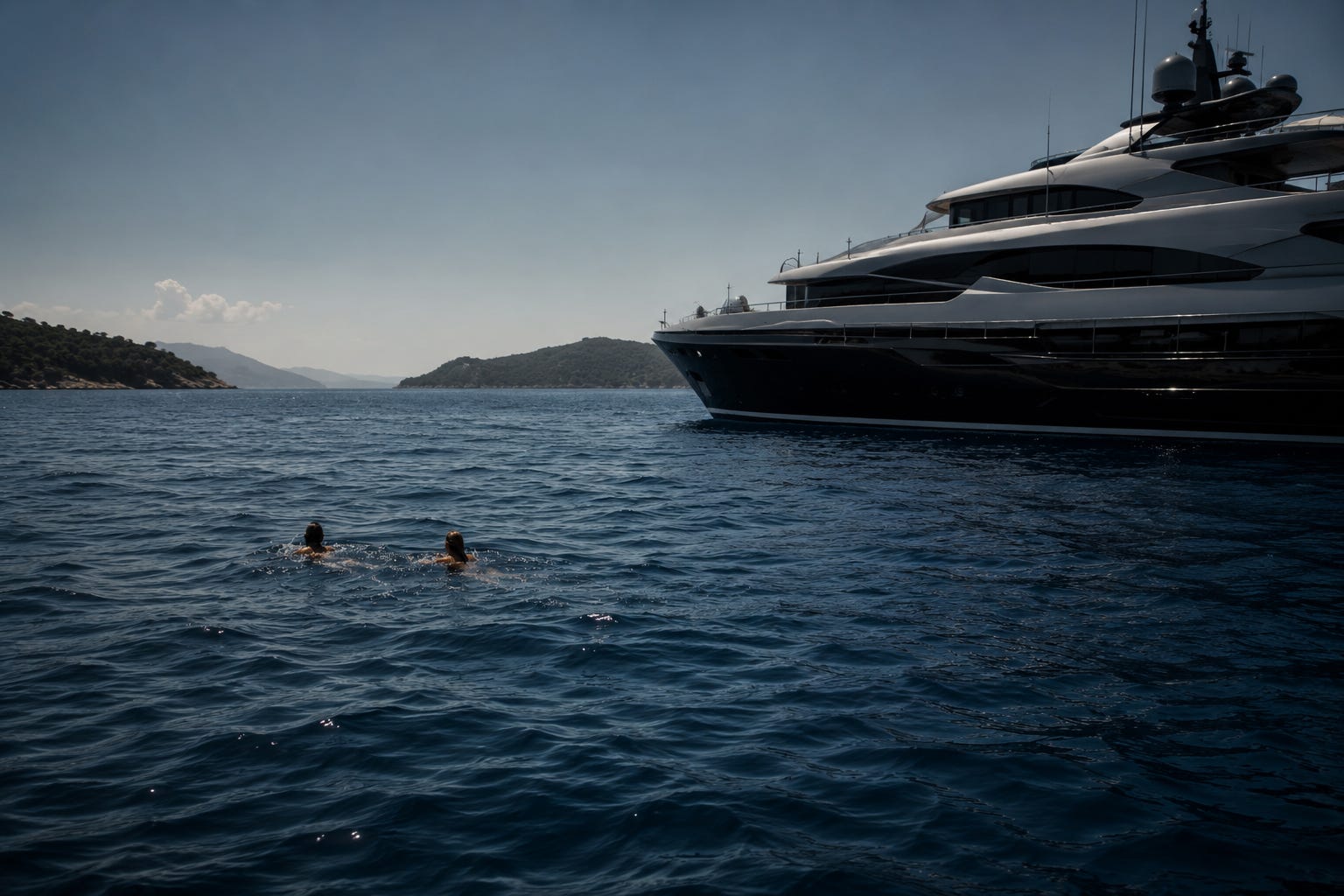
Part of my work involves travelling with clients at sea, often aboard yachts, in environments where the gap between a calm day and a genuine emergency can close very quickly. Before any time on the water, these are the steps we run through. They are not complicated and they do not require specialist knowledge. They require only that you know them before you need them, because the moment you need them is not the moment you have time to learn them.
The moment you need them is not the moment you have time to learn them.
What the RNLI calls Float to Live works in a river, a lake, a reservoir and the open sea. The principle does not change with the environment.
Cold Water Shock
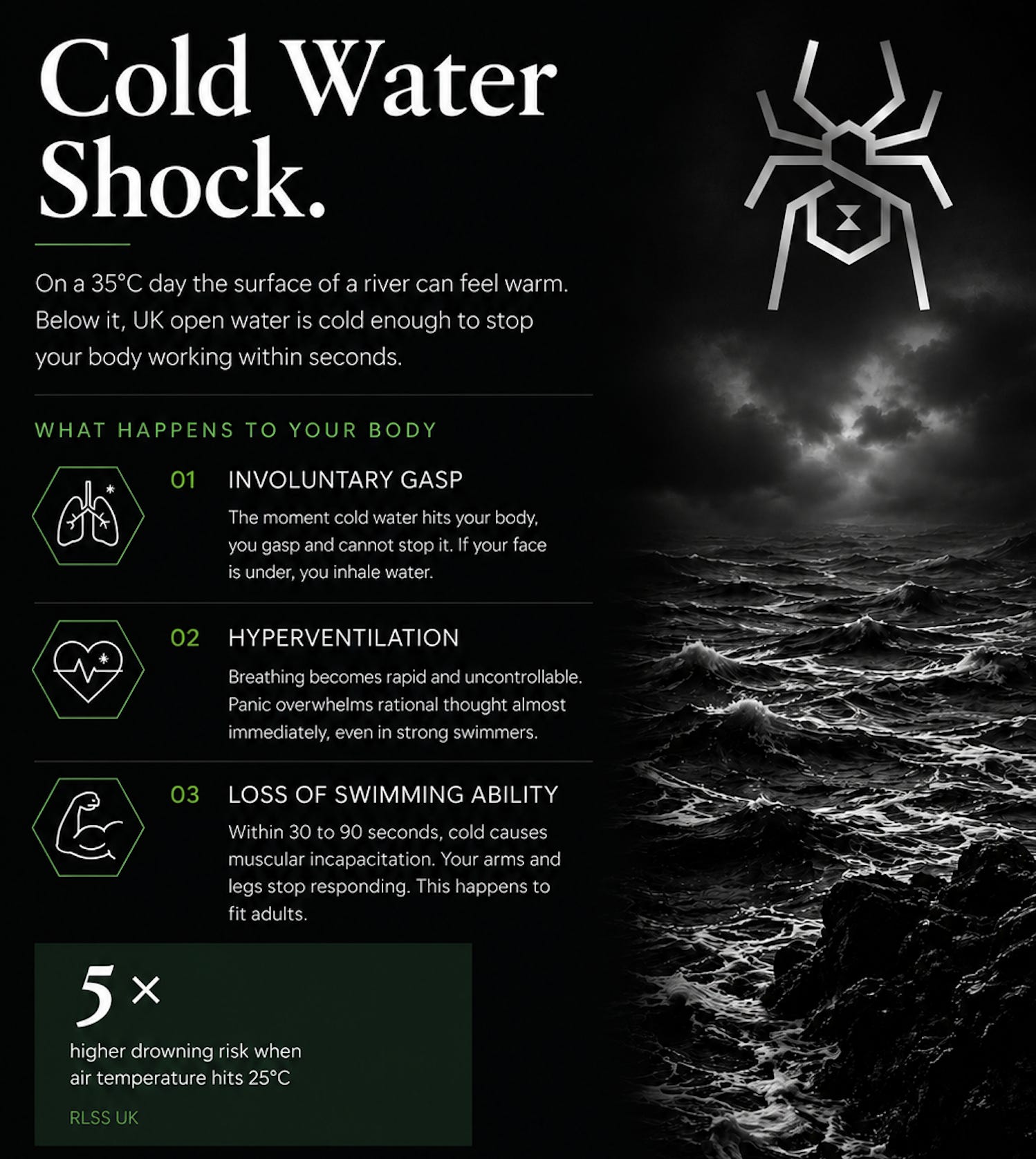
When your body enters cold water suddenly, it goes into shock. Your breathing becomes involuntary and completely uncontrollable, you gasp. If your face is below the water at that moment, you inhale it. Within 30 to 90 seconds, the cold causes muscular incapacitation and your ability to swim can disappear entirely, regardless of how fit you are, how strong a swimmer you are or how confident you feel going in.
This is called cold water shock and it is the reason that half of the people who drown in UK open water did not intend to enter the water at all.3 They slipped on a riverbank, they fell from a boat, or they went in to help someone else who was in trouble. The water responded to all of them in the same way.
The Royal Life Saving Society UK has confirmed that when air temperatures reach 25°C, the risk of accidental drowning increases fivefold.4 On a day of record-breaking heat, with thousands of people heading to rivers and lakes to cool down, that statistic is not abstract. It is what we have been watching play out across the country since Sunday.
‘Float to Live’
The RNLI has spent years researching and communicating this guidance, backed by scientific evidence from the University of Portsmouth’s Extreme Environments Laboratory confirming that the technique works for non-swimmers, for people who are fully clothed and in moving water as well as still.56
Tilt your head back and submerge your ears. This is the single most important physical adjustment you can make, as ithelps your body find its natural floating position.
Resist every instinct to thrash or swim hard and focus only on breathing. Once your breathing has steadied, move your hands and arms gently to help you stay afloat if you need to.
It is fine if your legs sink below the surface. Everyone floats differently and sinking legs do not mean you will go under.
Once your breathing is under control, call for help, signal to anyone nearby or swim calmly to safety if you are close enough to do so.
That is the whole technique. The difficulty is not learning it, the difficulty is remembering it in the moment when every instinct in your body is telling you to fight.
If You See Someone in Trouble
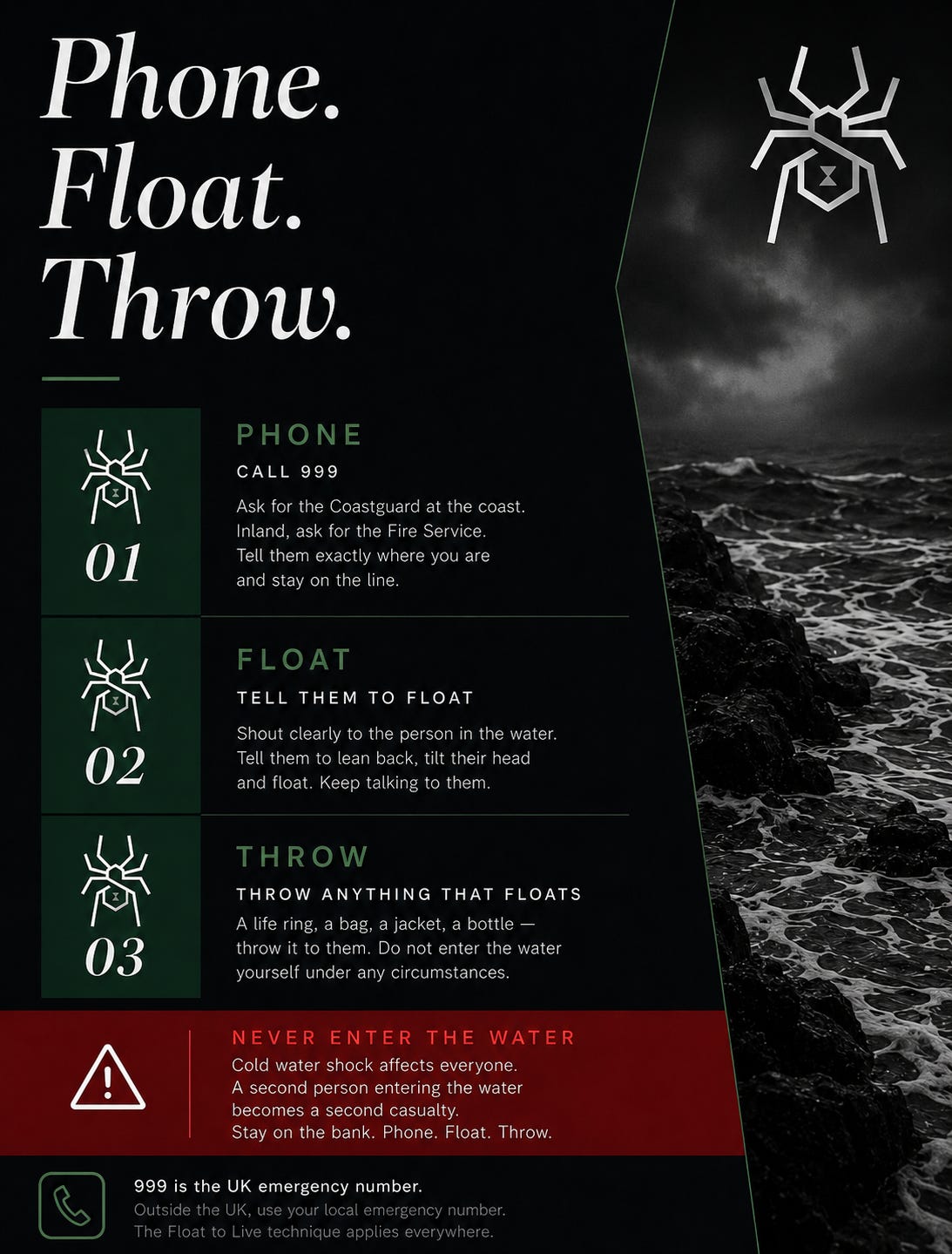
Do not enter the water. This is the instruction that saves the most lives and is ignored the most often, because the impulse to go in after someone you care about is overwhelming. A man in his sixties died this week attempting to help family members who were in difficulty.7
If you see someone struggling in open water, follow three steps:
Call 999 immediately and ask for the Coastguard at the coast or the Fire Service if you are inland. Tell them your exact location and what you can see, and stay on the line.
While you are on the phone or straight afterwards, shout clearly to the person in the water and tell them to lean back and float.
Then throw them something that floats, anything you have available, a bag, a jacket, a water bottle, a ball. Throw it within reach and keep talking to them.
Get help coming. Keep them floating. Do not go in.
Before you go near water this summer
These are simple habits that cost nothing and take no time, but they matter enormously.
01 - Only swim in lifeguarded locations wherever possible.
02 - If there is a lifeguard, swim between the red and yellow flags.8
03 - Enter the water gradually rather than jumping or diving in, because gradual entry gives your body time to adjust rather than triggering the full shock response.
04 - Never swim alone, and always tell someone where you are going and when you expect to be back.
05 - Be especially careful near riverbanks, which can be slippery, unstable and deceptively close to depth.
06 - If you are out on the water in a boat, know where the life rings and throw lines are before you need them.
If you are a parent or a carer, please share the Float to Live technique with the young people around you before they spend time near water this summer.
Please share this with anyone you know who is heading near water. And if you have children or young people around you this week, take five minutes to show them what Float to Live looks like before they go out.
A note for international readers: the emergency numbers in this piece are UK-specific. The water safety advice and the Float to Live technique apply everywhere.
Safety and Security. From Someone Hired to Protect.

Sources
Boy, 14, becomes 11th person to die in open water incidents during record heatwave — ITV News, 28 May 2026. https://www.itv.com/news/2026-05-28/may-bank-holiday-open-water-swimming-river-sea-deaths
Record-Breaking UK Heatwave: Teenagers Die Over Bank Holiday Weekend in Separate Drowning-Related Accidents — IBTimes UK, 28 May 2026. https://www.ibtimes.co.uk/bank-holiday-drownings-uk-heatwave-water-safety-1799365
193 Accidental Water-Related Fatalities in 2024 — National Water Safety Forum, University of Portsmouth, 2025. https://www.port.ac.uk/news-events-and-blogs/news/193-accidental-water-related-fatalities-in-2024
RLSS UK issues urgent water safety warnings following Bank Holiday drowning deaths — Royal Life Saving Society UK, May 2026. https://www.rlss.org.uk
RNLI launches Float to Live campaign for 2026 — Royal National Lifeboat Institution, 19 May 2026. https://rnli.org/news-and-media/2026/may/19/rnli-launches-it-float-to-live-campaign-for-2026
Inexperienced water users can Float to Live in open water conditions — University of Portsmouth Extreme Environments Laboratory, 2024. https://www.port.ac.uk/news-events-and-blogs/news/inexperienced-water-users-can-float-to-live-in-open-water-conditions
Boy, 14, becomes 11th person to die in open water incidents during record heatwave.
RNLI launches Float to Live campaign for 2026.
Another brilliant and well sourced article, the knowledge and techniques referenced can and do save lives and should be shared and shared again.
This is an excellent and genuinely useful piece because it reduces a frightening emergency to a small number of actions that can still be recalled under stress: control the breathing, float rather than fight the water, and for a bystander, call, instruct, and throw — do not enter.
One small technical distinction may strengthen it further: cold-water shock occurs immediately and is most acute during the first 30 seconds to two minutes, while cold incapacitation and progressive loss of swimming ability generally develop over the following 2–15 minutes. The practical advice remains exactly right, but separating those two phases would make an already potentially life-saving article even more precise.