

The Security Problem at 35,000 Feet
What a Bluetooth device named 'BOMB' reveals about the state of aviation security in 2026, and why the real story is considerably bigger than one person's poor judgement.


When I am working away from my computer, whether on a protective security detail or any other operational task, checking nearby Bluetooth devices is something I do regularly. On the face of it that might sound like an odd habit, but it is a genuinely useful one. A list of nearby devices gives you a quiet picture of who is around you, and if you are running anti-surveillance drills, seeing the same device name appear across different locations is exactly the kind of pattern that tells you something worth paying attention to. If that is of interest, the piece I published earlier this month on surveillance awareness goes into considerably more detail.
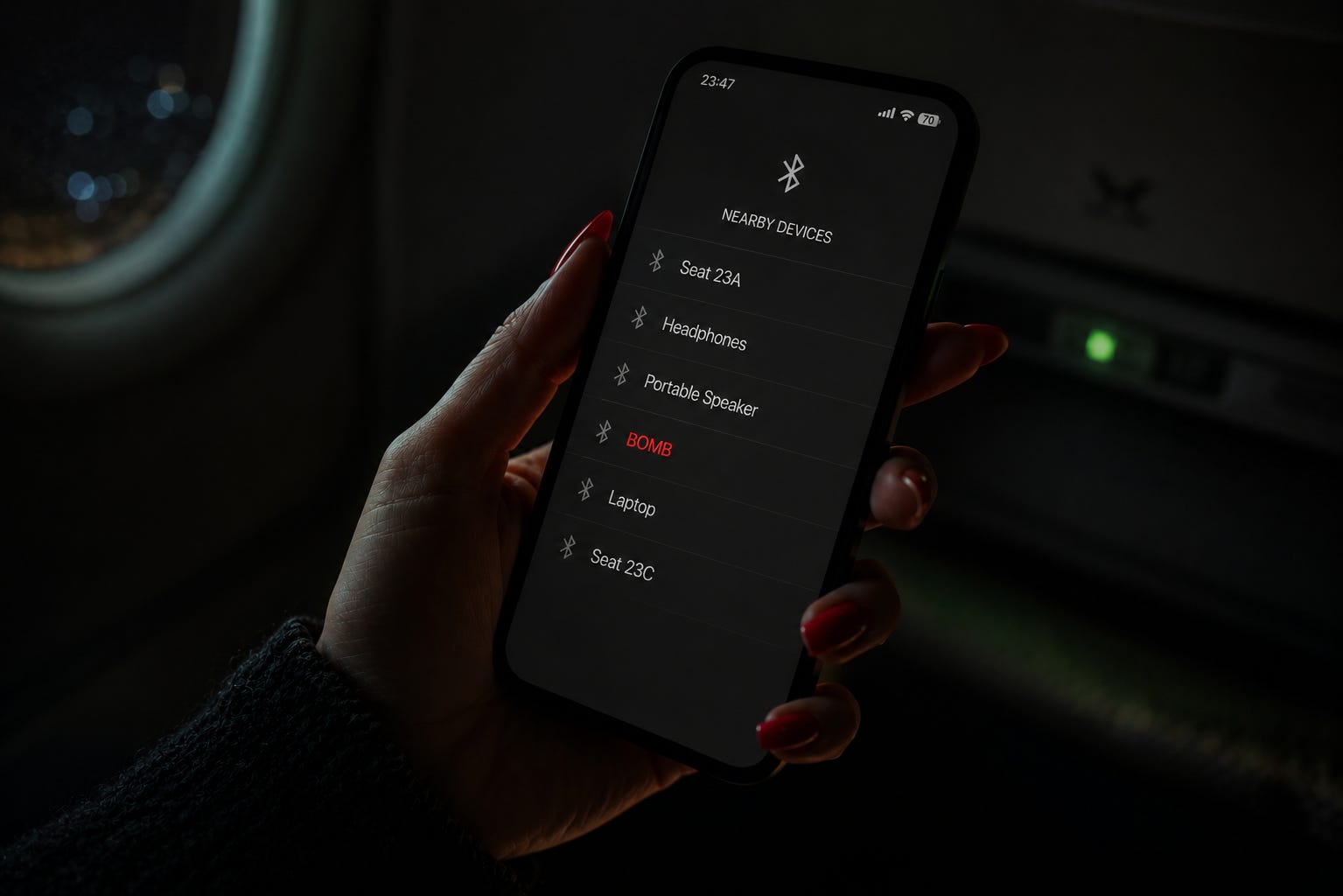
So when the story of United Airlines Flight 236 landed in my news feed, what caught my attention first was not the Bluetooth device named ‘BOMB.’ It was the fact that a passenger was looking at their nearby devices at all.
Whether out of habit, boredom or something they could not quite name, a passenger on a transatlantic flight scanned their Bluetooth connections, saw a device listed as ‘BOMB’ and told a flight attendant. Reports conflict on whether the device was a speaker or a Fitbit watch, but both sources agree it belonged to a sixteen-year-old on board. What happened next turned a routine crossing into a federal security operation.
Having worked with explosives during my military service, I know what that word represents and I know why any security team encountering it has no option but to respond as though it means exactly what it says.
Whether the device was a speaker or a fitness watch is entirely beside the point.
The proportionality of the response is not what I want to discuss here, what I want to discuss is what this incident, and the pattern of incidents surrounding it, reveals about the state of aviation security in 2026, because the answer is considerably more uncomfortable than one persons poor judgement.
This is Not an Isolated Incident
The UA236 incident is one point in a pattern that has been building throughout 2026. In January a Turkish Airlines flight from Istanbul to Barcelona was intercepted by fighter jets after a passenger named their hotspot with a bomb threat. In May a KLM flight from Malaga to Amsterdam was delayed for hours for the same reason.1 A United Airlines pilot threatened FBI involvement earlier the same month after a passenger broadcast an antisemitic Wi-Fi name on board.2 In April two United flights were evacuated on consecutive days following bomb threats, and in March a Southwest Airlines passenger was removed at gunpoint after law enforcement responded to a phone alarm set for Ramadan prayer time, while Kansas City International Airport was separately evacuated with two thousand passengers inside. 34
In 2024 alone, airlines worldwide reported 2,102 unruly passenger incidents.5 That figure predates the current geopolitical environment, which has sharpened how security services respond to anything that could be construed as a threat.
This is what is driving the pattern, and it is worth understanding properly.
The Passenger Problem
A significant number of passengers board commercial aircraft with no understanding of the security environment they are entering or the consequences of their actions within it.
Naming a device ‘BOMB’ and making it visible to a cabin full of strangers at 35,000 feet activates a sequence of events that costs the airline hundreds of thousands of pounds, strands two hundred people for the better part of a day, deploys law enforcement and federal agencies, and creates genuine fear for everyone on board who don’t know what is happening.
Aviation security operates on the principle that it cannot afford to be wrong.
A security team assessing a bomb threat cannot calibrate its response to the apparent intent of the person who made it. The protocol exists because the one time a situation that looked like a joke turned out not to be would be catastrophic. That logic is not bureaucratic but simply correct, and understanding it before you board is basic literacy that most passengers do not seem to have.
The Response Chain
Most passengers have no idea what actually happens when a security incident is declared on a commercial aircraft, and the gap between what they think is happening and what is actually happening is significant.
On UA236 the sequence began the moment a passenger reported the Bluetooth device to a flight attendant. The cabin crew escalated immediately to United’s operations centre in Chicago, which directed the on-board response. The flight deck squawked 7700, the universal emergency transponder code recognised by every Air Traffic Control (ATC) system in the world, which placed the aircraft on priority radar with an immediate alert and triggered a coordinated ground response.6 7 On landing, Port Authority police and federal teams were already in position, bomb disposal and canine units swept the entire aircraft, and the Transportation Security Administration (TSA) and Customs and Border Protection (CBP) conducted secondary screening of every person on board before anyone was permitted to re-board.8
From a passenger noticing a name on their phone to a full federal response on the ground in less than three hours. Every step correct was correct, but every step was completely avoidable.
The Bigger Threat Picture
The incidents described so far share something in common. They were caused by people making decisions, whether reckless, thoughtless or simply uninformed, and in theory they are preventable through awareness and education. What sits beneath that visible layer is a different category of threat entirely, one that no amount of passenger literacy can address and that most people flying today have no idea exists.
GNSS (Global Navigation Satellite System) interference is the umbrella term for deliberate disruption to the satellite signals that aircraft rely on for navigation, and it takes two primary forms:9 10
Keep reading with a 7-day free trial
Subscribe to Black Widow Security to keep reading this post and get 7 days of free access to the full post archives.